You’ve invested in a beautiful website design. The layout is clean, the images are professional, and the navigation makes sense. But something’s not clicking. Visitors land on your site, scroll for a few seconds, and then… they’re gone.
Sound familiar?
Here’s the thing: even the most stunning website design can’t compensate for weak copy. Your words are doing the heavy lifting when it comes to converting visitors into customers. But most business owners—understandably—aren’t copywriters. They’re experts in their own field, not in crafting conversion-focused messaging.
After working with dozens of companies on their website copy, I’ve seen the same mistakes pop up again and again. The good news? Once you know what to look for, these issues are fixable. Let’s dig into the seven most common website copywriting mistakes and, more importantly, how to avoid them.
1. Writing About Your Company Instead of Your Customer’s Problems
This is the big one. I see it on at least 80% of the websites that come across my desk.
The homepage starts with something like: “Founded in 2010, ABC Company is a leading provider of…” or “We are passionate about delivering exceptional service…”
Here’s the problem: your visitors don’t care about you. Not yet, anyway.
They care about their problems. They’re on your website because they’re looking for a solution to something that’s keeping them up at night. If your copy doesn’t immediately speak to those pain points, they’ll bounce faster than you can say “conversion rate.”
The fix: Lead with your customer’s challenges, not your credentials. Your “About Us” page is where you can share your story. Your homepage needs to hook visitors by showing them you understand what they’re dealing with.
2. Using Industry Jargon That Confuses Rather Than Clarifies
You know your industry inside and out. You’ve spent years mastering the technical details, the specialized terminology, the insider knowledge. That expertise is valuable—it’s what makes you great at what you do.
But your website copy needs to speak in your customer’s language, not yours.
When you pepper your copy with acronyms, technical terms, and industry buzzwords, you’re creating unnecessary friction. Your visitors have to work harder to understand what you’re actually offering. And when people have to work hard to understand your message, they leave.
The fix: Write like you’re explaining your service to a smart friend who’s not in your industry. Use simple, clear language. When technical terms are unavoidable, explain them in plain English. Your expertise should shine through in how you solve problems, not in how complex you can make your vocabulary.
3. Vague Value Propositions That Could Apply to Anyone
“We provide quality service.”
“We’re committed to excellence.”
“We put our customers first.”
These statements might be true, but they’re also completely generic. Every one of your competitors could say the exact same thing. Vague value propositions don’t differentiate you—they make you blend into the background.
The fix: Get specific about what makes you different. Instead of “quality service,” explain what that actually means for your customers. Do you respond to inquiries within an hour? Do you include three rounds of revisions in every project? Do you have a proprietary process that gets better results?
The gold in your brand messaging comes from specificity. Dig deep to uncover what truly sets you apart, then articulate it clearly.
4. Missing or Weak Calls-to-Action
You’d be surprised how many websites I encounter that don’t clearly tell visitors what to do next. The copy might be decent, but there’s no clear path forward. Or worse, every section has a different call-to-action, creating decision paralysis.
Your website needs to guide visitors toward a specific action. Whether that’s scheduling a call, requesting a quote, or downloading a resource, make it crystal clear what the next step should be.
The fix: Each page should have a primary call-to-action that aligns with where visitors are in their buyer journey. Homepage? Probably a consultation or discovery call. Service page? Maybe a free assessment or quote. And make sure your CTAs use action-oriented, benefit-focused language. “Schedule Your Free Website Audit” beats “Contact Us” every time.
5. Writing Without a Clear Structure or Flow
Good website copy isn’t just about individual sentences being well-written. It’s about how those sentences work together to guide visitors through a logical journey.
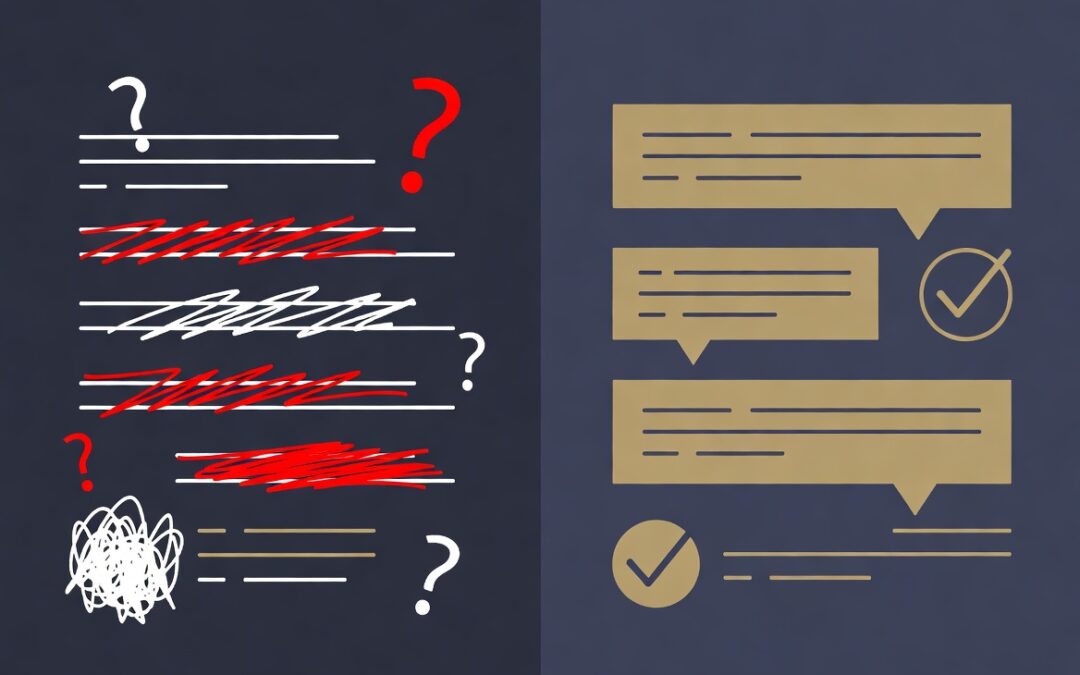
Many business owners approach their website copy like a brain dump—throwing everything they want to say onto the page without considering the order or flow. The result is a jumbled mess that leaves visitors confused about where to focus their attention.
The fix: Your copy needs a strategic structure. Start with the problem, introduce your solution, back it up with proof (testimonials, case studies, credentials), address common objections, and close with a clear call-to-action. This sequence isn’t arbitrary—it mirrors how people naturally make buying decisions.
Think of your website copy as a conversation you’re having with a potential customer. You wouldn’t randomly jump between topics in an actual conversation, so don’t do it in your copy.
6. Forgetting to Include Social Proof
You could write the most compelling copy in the world, but if you’re asking visitors to take your word for it, you’re making the sale harder than it needs to be.
Social proof—testimonials, reviews, case studies, client logos—builds trust. It shows potential customers that real people have worked with you and gotten real results. Without it, you’re asking people to take a leap of faith.
The fix: Strategically place testimonials throughout your website, not just on a dedicated testimonials page. Use specific testimonials that highlight different aspects of your service or different types of results. The more specific the testimonial, the more powerful it is. “James helped us increase conversions by 40% in three months” is far more compelling than “James was great to work with.”
7. Not Optimizing for Both Humans and Search Engines
Here’s a tension every website faces: you need to write copy that appeals to humans and satisfies search engines. Many business owners swing too far in one direction.
Some write entirely for SEO, stuffing keywords into every sentence until the copy becomes robotic and unreadable. Others completely ignore SEO, writing beautiful prose that no one can find.
The fix: The best website copy serves both masters. Use relevant keywords naturally, especially in headlines and key positions. But never sacrifice readability for SEO. Search engines are getting smarter—they can tell when you’re keyword stuffing, and they’ll penalize you for it.
Write for humans first, then optimize for search engines. Include your target keywords in places that make sense: your page title, H1 tag, meta description, and naturally throughout the body copy. But if a sentence reads awkwardly with a keyword forced in, rewrite it.
The Bottom Line
Great website copy doesn’t happen by accident. It requires strategy, research, and an understanding of both your audience and conversion principles.
If you’re seeing these mistakes on your own website, don’t panic. Recognizing the problem is the first step toward fixing it. Some of these issues you can tackle yourself with a fresh eye and a willingness to rewrite. Others might require bringing in a professional who can objectively assess your messaging and uncover the unique value in your brand.
The investment in strong website copy pays dividends. It’s the difference between a website that sits there looking pretty and a website that actually works to grow your business. Your design brought visitors to the page—now it’s your words’ job to keep them there and convert them into customers.
And that makes all the difference.