You hired a professional copywriter. They did their research, wrote your copy, and delivered it for review. Now you’re staring at a Google Doc full of words, and you’re not sure what to do.
You know something needs to change, but you can’t quite articulate what. Or maybe you love it all except for this one section that feels off. Or perhaps your business partner has completely different opinions than you do, and now you’re stuck mediating.
Reviewing website copy is tricky. It’s not as straightforward as reviewing a design where you can say “make that button bigger” or “change that color to blue.” Copy is about nuance, strategy, and psychology. Good feedback requires a different approach.
After working with dozens of clients through the review process, I’ve learned what makes feedback productive versus what derails projects. Let me show you how to review copy effectively—so you get the results you want without endless revision rounds.
The Fundamental Mindset Shift
Before you make a single comment, understand this: you are not the target audience for your website copy.
I know, I know. It’s your business. You’re reading words about your company. Of course you care what they say.
But your opinion of the copy matters much less than whether it resonates with your customers and drives them to action.
Your job in reviewing copy isn’t to make it sound the way you would say it. It’s to evaluate whether the copy will work for your target customers based on the strategy you agreed to upfront.
This mindset shift is huge. When you stop asking “Do I like this?” and start asking “Will this convert my customers?”, your feedback becomes infinitely more valuable.
Before You Start Reviewing
Don’t dive straight into the document and start making comments. Take these steps first:
Re-read the creative brief or strategy document. Remind yourself what goals were established, who the target audience is, and what key messages were prioritized. The copy should be evaluated against these criteria.
Read through the entire draft once without commenting. Get a feel for the overall flow and messaging before fixating on individual sentences. You might have concerns about paragraph two that get addressed by paragraph five.
Check your emotional state. Are you stressed, rushed, or in a bad mood? Your feedback will reflect that. Review copy when you can give it proper attention and fair evaluation.
Gather relevant stakeholders. If multiple people need to review, coordinate their feedback rather than having everyone comment separately. Conflicting feedback from multiple stakeholders is the number one project killer.
Now you’re ready to actually review.
What to Evaluate: The Strategic Lens
Good copy review focuses on strategic questions, not subjective preferences. Here’s what to evaluate:
Accuracy
- Is everything factually correct?
- Are services and offerings described accurately?
- Are prices, timelines, and processes represented correctly?
- Are there any claims that can’t be backed up?
This is non-negotiable stuff. If something is wrong, it needs to be fixed.
Clarity
- Will your target customer immediately understand what you do?
- Is anything confusing or ambiguous?
- Does the copy assume knowledge your audience doesn’t have?
- Are there industry terms that need explanation?
If you have to re-read something three times to understand it, your customers will just leave.
Relevance
- Does the copy address problems your customers actually have?
- Are the benefits emphasized what customers actually care about?
- Is the tone appropriate for your audience?
- Does it position you correctly against competitors?
This requires you to think from your customer’s perspective, not your own.
Persuasiveness
- Does the copy make a compelling case for taking action?
- Are objections addressed?
- Is there appropriate proof (testimonials, data, credentials)?
- Are calls-to-action clear and motivating?
Remember, the goal is conversion, not just information.
Brand Alignment
- Does the voice feel like your brand?
- Is the personality consistent across all pages?
- Does it differentiate you from competitors?
- Would your customers recognize this as “you”?
Your copy should sound distinctly like your brand, not generic or like everyone else.
What NOT to Focus On
Just as important as what to review is what not to worry about:
Personal word preferences. “I would say ‘utilize’ instead of ‘use'” is not helpful feedback unless there’s a strategic reason. Professional copywriters choose words deliberately. Trust their expertise unless something is actually wrong.
Wanting it to sound exactly like you. Your copywriter isn’t trying to impersonate you. They’re trying to communicate effectively with your customers. Those might not sound the same.
Concerns about length. “This seems long” is only valid feedback if you can point to specific content that doesn’t serve a purpose. Strategic copy needs room to address objections and build a case. Don’t cut effective copy just because you personally wouldn’t read it all—not everyone reads like you do.
Style changes that don’t matter. Changing “you’ll” to “you will” or “get” to “obtain” is busywork. Focus on substance, not style minutiae.
Making it sound more corporate. Unless your brand strategy explicitly calls for formal corporate language, resist the urge to add jargon and formality. Clear, conversational copy usually converts better.
How to Structure Your Feedback
When you do have feedback, structure it in a way that’s actionable. Here’s how:
- Start with what works. “I love how the homepage immediately addresses our customers’ biggest pain point” is much better than starting with a list of problems.
- Be specific about concerns. Not helpful: “The services section doesn’t feel right.” Helpful: “The services section doesn’t emphasize our quick turnaround time, which is our biggest competitive advantage.”
- Explain the why. Not helpful: “Change this sentence.” Helpful: “This sentence feels too technical for our audience, who are typically non-technical buyers. Can we simplify?”
- Suggest solutions when possible. If you have a specific idea for how to fix something, share it. But remain open to your copywriter’s alternative solutions—they might be better.
- Prioritize your feedback. Mark things as “must fix” versus “nice to have.” Not everything is equally important.
The Collaborative Revision Process
The best revision processes are collaborative, not adversarial. Here’s how to make it work:
Use a live review session. Rather than endless back-and-forth comments, schedule a video call with your copywriter to go through feedback together. You’ll make more progress in 60 minutes than in a week of email threads.
Ask questions. If something seems off, ask your copywriter why they made that choice. There’s often strategic reasoning you’re not seeing. Understanding their thinking helps you evaluate whether to change it.
Test objections. If you think something won’t work, explain why. “Our customers would never respond to that tone” is testable—is that actually true based on research, or just an assumption?
Focus on one round at a time. Don’t try to address strategic concerns and minor tweaks in the same revision. Fix big issues first, then polish.
Know when to let go. At some point, you need to stop revising and launch. Perfect is the enemy of done. If the copy is 90% there, ship it and adjust based on real-world performance.
Dealing with Multiple Stakeholders
If you have multiple people reviewing copy (executives, partners, board members), this can quickly become a nightmare. Here’s how to manage it:
Establish a single point of contact. One person collates all feedback and delivers it to the copywriter. Multiple people commenting directly on the document creates chaos.
Set expectations upfront. What’s each stakeholder’s role? Who has final say on strategic decisions versus word choices?
Resolve conflicts offline. If stakeholders disagree, work it out before sending conflicting feedback to your copywriter. They can’t execute on “make it warmer” and “make it more professional” simultaneously.
Limit revision rounds. “We’ll do two rounds of revisions” prevents infinite feedback loops. This forces stakeholders to be thoughtful and decisive.
Remember the strategy. When stakeholders disagree, refer back to your strategy document. The answer is usually there.
Common Feedback Pitfalls to Avoid
Pitfall 1: Death by committee When everyone has an opinion and no one has authority, projects stall. Designate a decision-maker.
Pitfall 2: Rewriting instead of reviewing Don’t rewrite sentences for your copywriter. Explain what’s not working and let them fix it. That’s what you hired them for.
Pitfall 3: Ignoring the strategy “I just don’t like how this sounds” isn’t useful unless you can tie it back to strategic concerns. Preferences need strategic justification.
Pitfall 4: Letting perfect be the enemy of good You can revise forever. At some point, ship the copy and adjust based on real-world performance. You’ll learn more from actual customer behavior than from internal debate.
Pitfall 5: Taking it personally Your copywriter isn’t criticizing your business when they position it a certain way. They’re applying conversion principles to help you succeed. Separate ego from strategy.
What Good Feedback Looks Like
Let me show you examples of helpful versus unhelpful feedback:
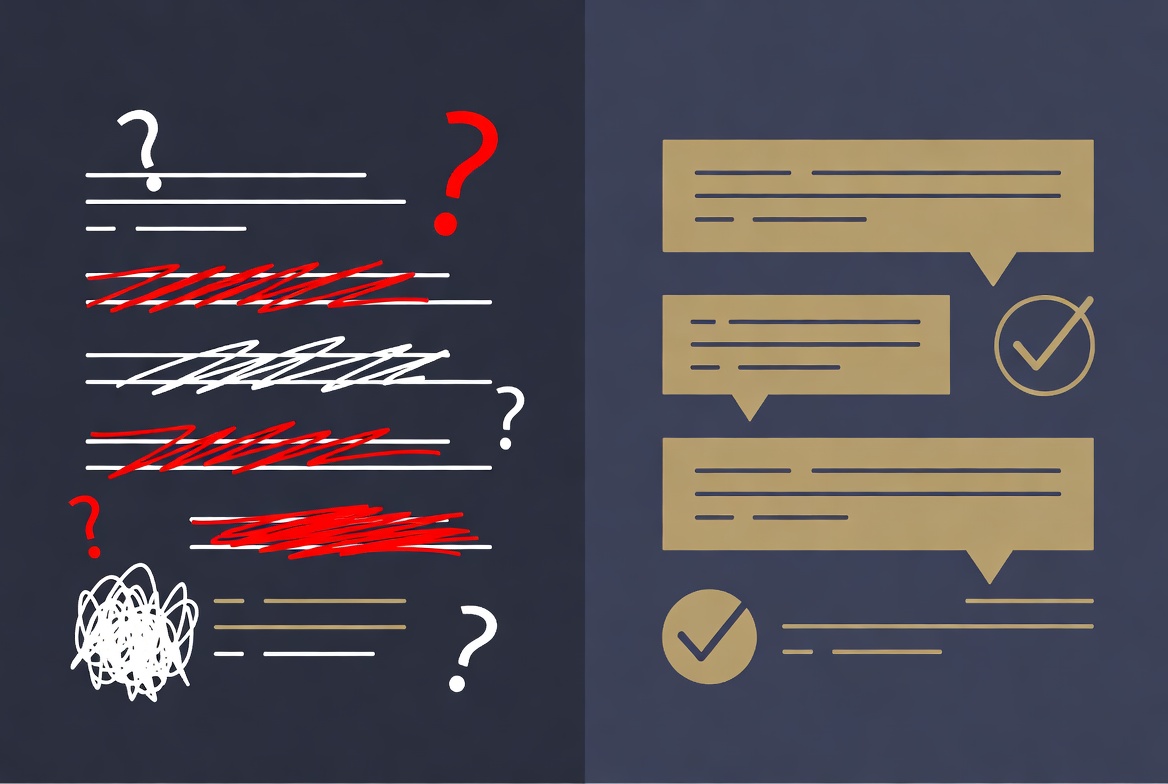
Unhelpful: “I don’t like this.” Helpful: “This positioning feels too generic. We need to emphasize our 24-hour turnaround time more prominently since that’s what customers consistently mention as our biggest differentiator.”
Unhelpful: “Make it sound more professional.” Helpful: “Our target audience is C-suite executives at Fortune 500 companies. This tone feels too casual for that audience. Can we adjust to be more professionally authoritative while staying clear and accessible?”
Unhelpful: “This is wrong.” Helpful: “We actually offer four tiers of service, not three. Also, the premium tier includes white-glove onboarding, which isn’t mentioned here.”
Unhelpful: “I would never say it that way.” Helpful: “When we interviewed customers, they consistently used the phrase ‘peace of mind’ to describe what they value. Can we incorporate that language since it resonates with them?”
See the difference? Good feedback is specific, strategic, and constructive.
After the Revisions
Once revisions are complete:
Approve it formally. Don’t let the copy sit in limbo. Either it’s approved and moves forward, or it needs another revision round.
Get it implemented quickly. Approved copy sitting in a Google Doc doesn’t help anyone. Get it on your live website where it can start working.
Track performance. Monitor how the copy actually performs. Conversion rates, time on page, bounce rates—these metrics tell you if the copy is working better than subjective opinions do.
Be willing to iterate. Even great copy can be improved based on real-world data. Plan to revisit and refine based on what you learn from actual customer behavior.
The Bottom Line
Reviewing website copy is a skill. It requires balancing strategic thinking with tactical feedback, maintaining the big picture while catching important details, and collaborating effectively with your copywriter.
The best copy reviews happen when clients:
- Evaluate against strategy, not personal preference
- Provide specific, constructive feedback
- Trust their copywriter’s expertise while bringing their business knowledge
- Focus on what matters and let go of what doesn’t
- Collaborate rather than dictate
Do this well, and you’ll get copy that works. Do it poorly, and you’ll end up with watered-down messaging that satisfies no one and converts poorly.
Your copywriter wants to deliver great work that drives results for your business. Your job is to help them do that through smart, strategic feedback.
Now you know how. Go forth and review wisely.