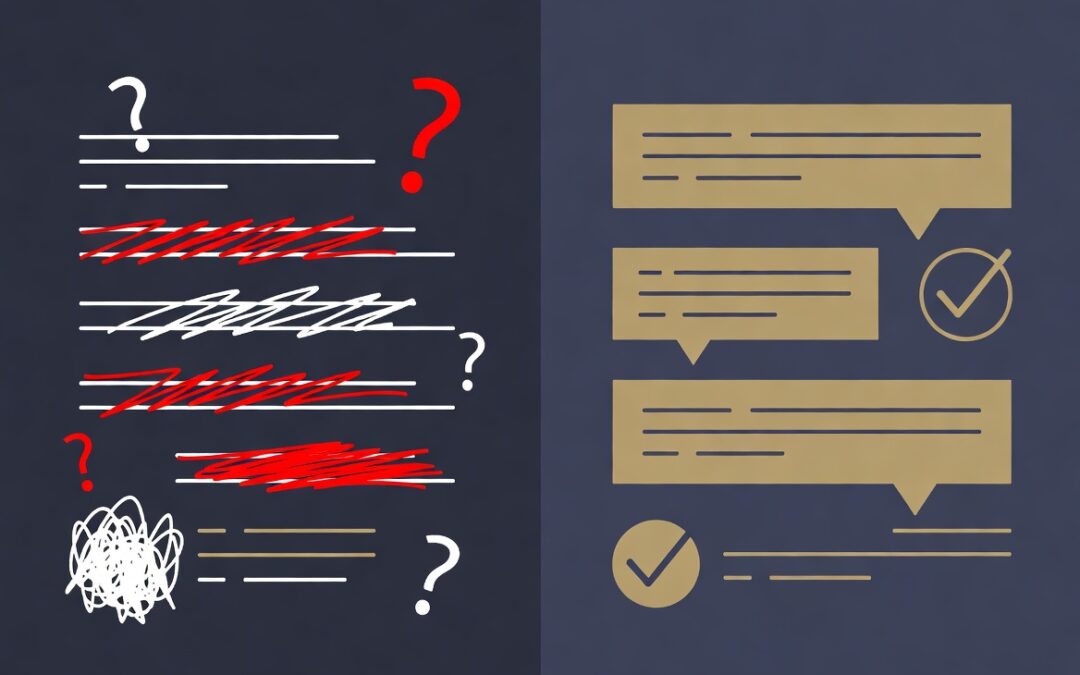

There’s a tension at the heart of every website project: you need to write copy that appeals to humans and satisfies search engines.
Get the balance wrong, and you end up with one of two problems. Either you stuff your content with keywords until it reads like a robot wrote it, turning off real visitors. Or you write beautiful, flowing prose that no one ever finds because search engines have no idea what your page is about.
The good news? You don’t have to choose between SEO and great copy. The best website copy serves both masters seamlessly. Here’s how to make that happen.
The Fundamental Truth About SEO Copywriting
Let’s start with what’s changed in the world of SEO.
Ten years ago, you could game the system. Stuff your target keyword into every paragraph. Hide text on your page. Buy a bunch of sketchy backlinks. Maybe it worked for a while.
Those days are gone. Search engines—especially Google—have gotten exponentially smarter. They can understand context, synonyms, and user intent. They can tell when you’re writing for humans versus gaming the algorithm.
Modern SEO copywriting is based on a simple principle: Write genuinely valuable content for humans, then optimize it strategically for search engines.
Notice the order there. Humans first. Search engines second.
When you create content that people actually want to read, share, and link to, the SEO largely takes care of itself. Google’s entire business model depends on showing people the best, most relevant results. If your content truly serves your audience better than competitors’ content, Google wants to rank you.
Your job is to make it easy for search engines to understand what your content is about and who it serves.
Understanding Search Intent
Before you write a single word, you need to understand what people are actually looking for when they search for your target keywords.
Search intent falls into four main categories:
Informational intent: People want to learn something. “What is conversion copywriting?” or “How to write a headline.”
Navigational intent: People are looking for a specific website or page. “James Thole copywriter” or “Mailchimp login.”
Commercial investigation: People are researching before making a decision. “Best copywriting services Denver” or “Mailchimp vs Constant Contact.”
Transactional intent: People are ready to take action. “Hire website copywriter” or “Buy project management software.”
Your content needs to match the intent behind the search. If someone searches “how to write website copy,” they want a guide—not a sales pitch for your services. If they search “hire website copywriter,” they’re ready to see your services and pricing.
This matters because Google evaluates whether your content satisfies the searcher’s intent. Great SEO copywriting delivers exactly what the search query implies.
Keyword Research That Actually Helps
Keyword research sounds technical and intimidating. But at its core, it’s just figuring out what words and phrases your potential customers use when looking for what you offer.
Start with the obvious keywords—the services you offer, the problems you solve. Then expand from there:
Use keyword research tools: Tools like SEMrush, Ahrefs, or even Google’s Keyword Planner show you search volume, competition, and related keywords. You don’t need expensive tools—even free versions give you valuable insights.
Mine “People Also Ask” boxes: When you search for your topic, Google often shows related questions. These are gold for understanding what people actually want to know.
Check “related searches”: Scroll to the bottom of Google search results to see related search terms. These reveal how people talk about your topic.
Analyze competitor content: Look at what keywords top-ranking competitors target. You don’t need to copy them, but it shows you what’s working.
Talk to real customers: Your customers’ actual language is more valuable than any keyword tool. How do they describe their problems? What terms do they use?
The goal isn’t to compile a massive list of keywords. It’s to understand the landscape so you can write naturally while strategically including relevant terms.
Strategic Keyword Placement
Once you know your target keywords, you need to use them strategically. But “strategically” doesn’t mean “constantly.”
Here’s where keywords matter most:
Page title (H1 tag): This is your most important keyword placement. Your main headline should include your primary keyword naturally. Not “COPYWRITING SERVICES FOR BUSINESSES THAT NEED COPYWRITING” but “Website Copywriting Services That Convert Visitors Into Customers.”
URL: Keep it short and include your main keyword. “yoursite.com/website-copywriting-services” is better than “yoursite.com/services-page-1.”
Meta description: While not directly a ranking factor, your meta description influences click-through rates. Include your keyword and make it compelling enough that people want to click.
First paragraph: Include your primary keyword early, ideally in the first 100 words. But make it natural—this is still for human readers first.
Subheadings (H2 and H3 tags): Sprinkle your primary keyword and related terms into some (not all) of your subheadings. This helps search engines understand your content structure.
Throughout the body: Use your keyword a few times throughout the content, but never force it. Focus on natural language and synonyms. If you’re writing about “website copywriting,” you’ll naturally also mention “web copy,” “website content,” “site messaging,” etc.
Image alt text: Describe your images accurately and, where relevant, include keywords. But don’t stuff—alt text is primarily for accessibility.
Here’s what you DON’T do: repeat the same keyword in every paragraph. That’s called keyword stuffing, and it makes your content unreadable while potentially getting you penalized by Google.
Writing Naturally While Being SEO-Conscious
The art of SEO copywriting is making optimization invisible. Readers shouldn’t feel like they’re reading SEO content—they should feel like they’re reading helpful, well-written content.
Here’s how to pull that off:
Write first, optimize second. Get your ideas down naturally. Say what needs to be said in the way that makes the most sense. Then go back and strategically incorporate keywords where they fit naturally.
Use variations and synonyms. If your target keyword is “website copywriting,” also use “web copywriting,” “site copy,” “website content writing,” etc. Search engines understand these are related. Plus, it makes your writing less repetitive.
Focus on topics, not just keywords. Instead of obsessing over one keyword, cover the topic comprehensively. If you’re writing about website copywriting, naturally you’ll discuss research, headlines, calls-to-action, conversion principles—all related concepts that support your main topic.
Let readability win. If a sentence reads awkwardly with a keyword, rewrite it without the keyword. A slightly less optimized sentence that people actually read is better than a perfectly optimized sentence that makes people bounce.
The Importance of Content Structure
Search engines favor well-organized content because it’s easier for users to read and extract value from.
Use this structure:
Clear hierarchy: H1 for your main headline, H2 for major sections, H3 for subsections. Don’t skip levels or use heading tags just for styling.
Short paragraphs: Big walls of text are intimidating and hard to scan. Break up your ideas into digestible chunks—aim for 2-4 sentences per paragraph.
Bullet points and lists: When presenting multiple items or steps, use formatting that makes them easy to scan.
Bold key phrases: Draw attention to important points. This helps readers scan and signals to search engines what matters most.
White space: Give your content room to breathe. Dense, cramped text discourages reading.
This isn’t just about SEO—it’s about respecting your reader’s time and cognitive load. But search engines notice these signals too.
Content Length: How Much Is Enough?
There’s no magic word count for SEO. You’ll hear people say “aim for 1,500 words” or “longer content ranks better.”
The truth is more nuanced: comprehensive content tends to rank well because it thoroughly addresses the topic. But length alone doesn’t guarantee success.
The right length for your content is however many words it takes to fully answer the search intent. No more, no less.
A page about “what is website copywriting” might only need 800 words to deliver value. A comprehensive guide to “how to improve your website conversion rate” might need 3,000+ words to cover the topic properly.
Don’t pad your content to hit an arbitrary word count. And don’t artificially cut valuable information because you think it’s too long. Let the topic and the audience’s needs determine the length.
Technical SEO Basics for Copywriters
While you might have a developer handling technical SEO, copywriters should understand these basics:
Page speed matters: Large images and bloated code slow down your pages. Compress images before uploading. If your content management system offers optimization, use it.
Mobile optimization is non-negotiable: More than half of web traffic comes from mobile devices. Your content needs to be easily readable on small screens.
Internal linking: Link to other relevant pages on your site. This helps search engines understand your site structure and keeps visitors engaged longer.
External linking: Link to authoritative sources when citing information. It shows you’ve done your research and adds credibility.
URL structure: Keep URLs clean and descriptive. “yoursite.com/website-copywriting-guide” beats “yoursite.com/?p=12345.”
Common SEO Copywriting Mistakes
Mistake 1: Optimizing for the wrong keywords
It doesn’t matter how well you optimize if you’re targeting keywords nobody searches for or keywords that don’t match your business goals. Do the research first.
Mistake 2: Ignoring user experience
SEO isn’t just about getting people to your site—it’s about keeping them there and getting them to engage. If visitors bounce immediately, that signals to Google your content isn’t valuable.
Mistake 3: Thin content
A 200-word page that barely scratches the surface of a topic won’t rank well. Aim for comprehensive coverage that genuinely helps your audience.
Mistake 4: Duplicate content
Don’t publish the same content on multiple pages of your site. Each page should have unique, valuable content.
Mistake 5: Neglecting meta descriptions
While they don’t directly impact rankings, meta descriptions affect click-through rates. Write compelling descriptions that include your keyword and make people want to click.
Measuring SEO Copywriting Success
How do you know if your SEO copywriting is working?
Track these metrics:
Organic traffic: Are more people finding your site through search?
Keyword rankings: Are you moving up in search results for your target keywords?
Time on page: Are people actually reading your content or bouncing immediately?
Bounce rate: What percentage of visitors leave after viewing just one page?
Conversions: Ultimately, are people taking the actions you want—signing up, contacting you, making purchases?
SEO is a long game. Don’t expect results overnight. But over weeks and months, you should see steady improvement if you’re consistently publishing quality, optimized content.
The Bottom Line
SEO copywriting isn’t about tricking search engines or gaming algorithms. It’s about creating genuinely valuable content that serves your audience, then making sure search engines can understand and rank it appropriately.
When you prioritize readability and value while implementing smart SEO practices, you get the best of both worlds: content that ranks well and converts visitors once they arrive.
The businesses that win aren’t choosing between SEO and great copy. They’re investing in both, understanding that the two work together to drive sustainable growth.
That’s the future of website content—and it’s more effective than either approach would be alone.