
Website Copywriter vs DIY: What’s Best for Your Business?

by | Jan 23, 2026 | Blog

Hire Website Copywriter vs DIY: Making the Best Choice for Your Business Success

Choosing between hiring a website copywriter and doing your own website copy is a decision about skill, time, and measurable business outcomes. This article explains the difference between DIY website copy and professional copywriting, the mechanisms that drive conversion-focused content, and how making the right choice improves SEO, brand voice, and lead quality. Many founders and marketing teams face a common pain point: unclear messaging that fails to convert visitors into customers. This guide will help you evaluate benefits, risks, timing, and ROI so you can decide whether to DIY, hire a pro, or use a hybrid approach. You’ll get practical checklists for decision-making, comparisons of hidden costs, an analysis of how AI fits into the workflow, and a clear picture of when professional services accelerate growth. Keywords explored include hire copywriter vs diy, professional copywriter benefits, diy website copy, and copywriting ROI for small business.

What Are the Benefits of Professional Website Copywriting?
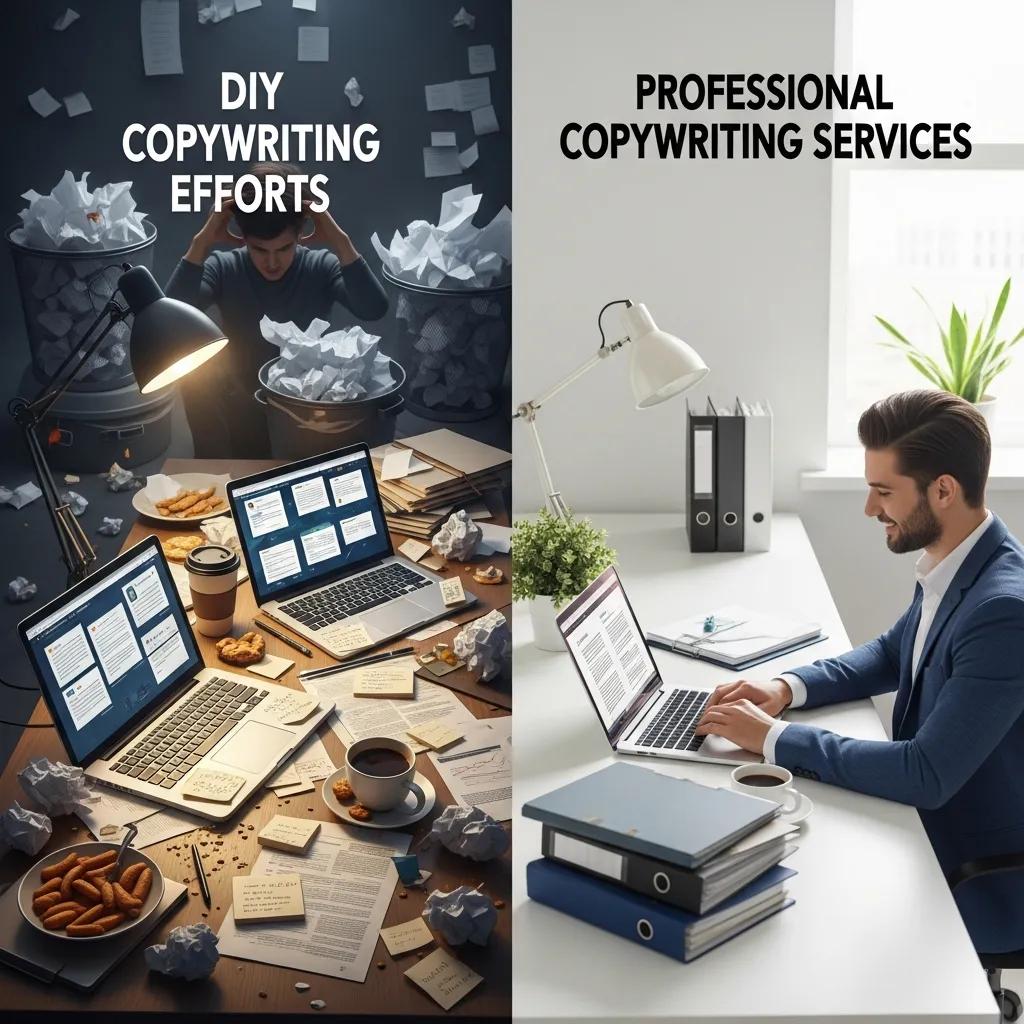
Professional website copywriting turns scattered ideas into a structured customer journey that consistently converts visitors into leads. Expert copywriters apply persuasive frameworks, headline science, and semantic keyword mapping to align visitor intent with clear calls to action, which increases conversion rates and reduces bounce. That structured approach also supports organic search by integrating SEO-optimized headings, intent-driven content, and internal linking strategies that improve discoverability. The net result is clearer messaging, faster time-to-value, and measurable uplifts in engagement and lead quality.

Professional copywriting offers several strategic benefits:

  1. Improved conversions through tested persuasive structures and clear calls to action.
  2. Better SEO performance via keyword intent mapping and semantic optimization.
  3. Consistent brand voice that builds trust and reduces friction across the buyer journey.
  4. Time savings for internal teams, enabling focus on product and growth priorities.

These benefits are interdependent: better SEO brings the right visitors, persuasive structure converts them, and a consistent brand voice increases lifetime value. Understanding the mechanics of how experts influence SEO and conversion rates clarifies why professional copy often outperforms DIY efforts.

How Does Expert Copywriting Improve SEO and Conversion Rates?

Expert copywriting improves SEO and conversion rates by matching keyword intent with persuasive page structure and measurable CTAs. Copywriters research search intent, map semantic keywords to page topics, and craft headlines, benefit statements, and microcopy that guide users toward conversion. They also plan internal linking and content architecture so search engines understand page relationships and topical authority. Finally, professionals iterate through testing—A/B testing headlines, CTAs, and value propositions—to quantify uplift and refine messaging over time.

This process yields specific improvements: higher organic rankings for intent-driven queries, longer session durations due to clear value statements, and increased form completions because CTAs match the visitor’s next logical step. Those mechanisms connect directly to conversion-focused strategy and explain why SEO and CRO improvements often occur together.

Why Is Consistent Brand Voice Important in Website Copy?

Consistent brand voice functions as a trust signal that reduces cognitive friction and accelerates buyer decisions across touchpoints. When tone, terminology, and messaging hierarchy remain stable, visitors recognize the brand, understand its value quickly, and move through the funnel with fewer objections. Inconsistent voice creates confusion, dilutes differentiation, and forces teams to spend time reconciling mixed messages internally. A consistent voice is also easier to scale across channels—emails, landing pages, and ad creative—so marketing efforts compound rather than contradict.

Creating that consistency requires a messaging framework and guidelines that translate into page headlines, taglines, and CTAs designers and developers can implement easily. The next section looks at the DIY tradeoffs when teams attempt to maintain voice and performance without specialist support.

What Are the Pros and Cons of DIY Website Copy?

Doing your website copy in-house delivers immediate editorial control and lower upfront cost, but it often hides long-term tradeoffs in time, expertise, and results. DIY works well for rapid experiments, micro-sites, or founders testing ideas, because decision cycles are short and iterations are fast. However, DIY can produce inconsistent messaging, missed keyword intent, and missed conversion opportunities when writers lack persuasion training or SEO experience. Balancing these tradeoffs requires understanding both the surface savings and the hidden costs.

The following list highlights the main pros and cons to help you weigh the choice:

  1. Pros: Lower direct costs, immediate control over wording, and fast iteration for prototype pages.
  2. Cons: Potentially lower conversion rates, inconsistent brand voice across pages, and weaker SEO performance.
  3. When appropriate: Early-stage tests, one-off pages, or teams with strong writing and SEO skills.

Even when DIY seems attractive, teams should track opportunity costs like time spent by founders, lost leads due to unclear CTAs, and extra development cycles for rewrites. The table below compares DIY and professional approaches across core attributes to make these tradeoffs concrete.

Different approaches produce different outcomes across measurable attributes.

ApproachCharacteristicTypical Impact
DIY CopyLow upfront monetary costShort-term savings but variable conversion results
Professional CopyResearch-driven processHigher conversion, consistent voice, better SEO
Hybrid (Edit + Pro)Internal drafts + expert polishFaster launch with improved quality

What Cost Savings and Brand Control Does DIY Copy Offer?

DIY copy reduces initial cash outlay and preserves hands-on control, which can be crucial for bootstrapped teams and rapid experimentation. Teams that write their own copy save on vendor fees and can publish faster without procurement cycles, enabling quick learning loops. However, those time savings are offset when staff must split focus between core product work and crafting persuasive, SEO-ready copy. To maximize DIY advantages, use templates, a content audit, and clear editorial guidelines so control doesn’t turn into inconsistent output.

If you plan to DIY, set guardrails: target keyword lists, headline formulas, and a short messaging doc to maintain coherence across pages. Those frameworks reduce rework and make it easier to hand off for professional polishing later.

What Hidden Challenges and Risks Come with Writing Your Own Website Copy?

Hidden challenges of DIY copy often show up as delayed launches, diluted positioning, and missed revenue opportunities that are hard to trace back to poor messaging. Non-specialists commonly underestimate the research time required for customer interviews, competitor mapping, and intent-driven SEO research, which prolongs projects. Poorly optimized pages can draw the wrong traffic, creating high bounce rates and low conversion despite solid product-market fit. The long-term cost may include lost deals, more expensive paid acquisition to compensate, and wasted design/dev resources on rewrites.

Recognizing these risks early helps teams choose a hybrid model: write initial drafts to capture authenticity, then invest in professional optimization for high-impact pages.

SituationAttributeRecommended Action
Early-stage testingSpeed prioritizedDIY with templates
High-traffic landing pagesRevenue at stakeHire a professional
Redesign with agencyIntegrated deliverables neededEngage professional copywriter

When Should You Hire a Professional Website Copywriter?

Hire a professional website copywriter when business goals depend on clear messaging, measurable lead growth, or when technical complexity demands translation into customer-facing language. High-stakes situations—major redesigns, product launches, fundraising pages, or conversion-critical funnels—benefit most from a strategic copy approach. Professionals accelerate launches by delivering research-backed messaging and designer-friendly copy that reduces iteration and aligns teams. The result is faster time-to-value and higher quality traffic converting at better rates.

Common scenarios that indicate hiring a pro include the following list, useful as a quick decision checklist:

  1. Website redesigns or agency projects where copy and design must align precisely.
  2. Pages that directly drive revenue, such as pricing, trial sign-up, or lead-magnet landing pages.
  3. Complex or technical products that need translation into customer-focused benefits.
  4. Fundraising or sales enablement materials where messaging precision matters.

These scenarios reflect where the opportunity cost of DIY typically exceeds the cost of hiring a specialist. To make this actionable, the table below maps business situations to recommended actions so teams can match risk to resource allocation.

Business situations map to clear actions that reduce launch risk and improve outcomes.

Business SituationRisk if DIYRecommended Action
Agency-led redesignMisaligned deliverablesHire a copywriter for integrated handoffs
High-volume traffic pageLost revenuePrioritize professional conversion copy
Technical product launchMessaging confusionHire for specialist translation
Early rapid testLow riskDIY or hybrid approach

Toward the end of this decision process, it helps to review what hiring a professional looks like in practice. James Thole Copywriting specializes in transforming unclear website messaging into conversion-focused copy. The firm’s positioning emphasizes research-backed structure and deliverables that are designer-friendly and SEO-optimized, which exemplifies how a strategic hire typically operates. Considering this model clarifies what to expect when paying for a professional engagement and helps teams compare vendor offerings against desired outcomes.

Which Business Goals and Situations Indicate the Need for Expert Copywriting?

Specific business goals that strongly indicate hiring an expert include improving conversion rates for lead generation, clarifying complex product messaging, preparing for scale, and aligning messaging for partnerships or investor materials. When a single page or funnel accounts for meaningful revenue, the precision of language can materially change business metrics. Similarly, if a product requires translating technical features into user benefits, a copywriter’s ability to conduct customer interviews and distill messaging saves time and avoids costly misalignment. Hiring is also recommended when internal bandwidth is limited and the cost of delay or poor performance is higher than vendor fees.

These triggers help prioritize budget and timing, making the hiring decision less subjective and more tied to measurable goals.

How Does Budget, Time, and Expertise Affect Your Copywriting Decision?

Budget, time-to-launch, and available expertise form a simple decision matrix for copywriting choices: low budget and quick timeline favor DIY or template-driven work; moderate budget with high stakes favors hiring a pro; and limited internal expertise suggests outsourcing to avoid rework. Time pressure often forces tradeoffs: rushing copy increases the risk of unclear CTAs and repeated design cycles, while investing in professional discovery upfront reduces iteration. Expertise matters because SEO-optimized, conversion-focused copy requires research, testing, and messaging discipline that non-specialists rarely sustain.

Use this quick checklist to decide:

  1. If budget is minimal and the page is low-stakes, DIY with templates is acceptable.
  2. If launch timing allows and the page is revenue-critical, hire a professional.
  3. If the internal team lacks SEO or conversion experience, prioritize hiring or hybrid support.

Understanding these thresholds makes budget decisions pragmatic rather than emotional.

How Does AI Influence the Website Copywriter vs DIY Decision?

AI tools change the DIY vs hire equation by speeding ideation and first drafts, but they do not replace strategic discovery, empathy, and testing that professional copywriters bring. For DIYers, AI can accelerate brainstorming, generate headline variants, and create structured outlines that reduce writer’s block. However, AI outputs need human framing, fact-checking, and tone alignment to avoid generic or inaccurate copy. Professionals use AI to generate variants and speed workflows while preserving strategic research and final human polish.

Can AI Tools Assist DIY Copywriting Effectively?

AI tools can assist DIY copywriters by generating drafts, suggesting headline alternatives, and helping map keyword clusters to page outlines. Strengths include speed, variant generation, and early-stage ideation which can make single-person teams more productive. Weaknesses are empathy, strategic prioritization, and nuanced brand voice—areas where AI often produces generic or off-brand language. Best practice for DIYers is to use AI for drafts and brainstorming, then perform human editing that focuses on intent, accuracy, and emotional resonance.

A simple AI-assisted workflow might be: research keywords → prompt AI for outline → draft content → human edit for voice and verification. This workflow preserves speed while reducing the risk of generic copy.How Do Professional Copywriters Leverage AI for Better Results?

Professional copywriters integrate AI as an efficiency layer: AI helps produce multiple variants and outlines, but the copywriter supplies research, testing plans, and final polishing. The augmentation model typically looks like research + human strategy → AI drafting → human editing and testing. This approach yields more rapid A/B tests, a wider set of CTA variants, and faster iteration while maintaining brand fidelity. Professionals also use AI for semantic keyword mapping and to explore alternative messaging angles that can be validated with real user testing.

Using AI this way keeps the strategic advantage of professional copy while lowering per-variant production time, which increases both efficiency and the pace of optimization.

What Is the ROI and Long-Term Value of Hiring a Professional Website Copywriter?

Hiring a professional copywriter delivers ROI through faster time-to-launch, higher conversion rates, and reduced rework, which together improve lifetime customer value and lower acquisition costs. Expert copy shortens design and development cycles by delivering designer-friendly copy that fits layout constraints and reduces iterations. Conversion uplifts—often measurable as percentage increases in form completions or trial sign-ups—translate directly into revenue gains that can justify the initial investment. Over the long term, consistent messaging also improves cross-channel performance for email, paid ads, and partner materials.

To make these benefits concrete, use the Entity-Attribute-Value table below to compare ROI drivers between a professional copywriter and a DIY approach.

RoleAttributeValue
Professional CopywriterTime to launchWeeks saved, fewer iterations
Professional CopywriterConversion liftHigher form completions and lead quality
DIYDirect costLower upfront spend, higher opportunity cost

How Does Expert Copywriting Save Time and Increase Sales?

Expert copywriters save time by providing research-backed outlines and designer-ready copy that minimizes back-and-forth with design and engineering teams. That efficiency reduces development cycles and frees internal teams to focus on product and growth activities. Sales increases arise from clearer value propositions and optimized CTAs that convert at higher rates; even modest percentage lifts in conversion can produce large revenue gains when applied to high-traffic pages. By viewing copy as an investment, businesses align content work with measurable outcomes rather than one-off editorial tasks.

Quantifying this effect often reveals that a single successful landing page rewrite can pay for multiple smaller copy projects through improved lead flow and conversion quality.

What Are the Hidden Costs of Poor DIY Website Copy?

Poor DIY copy carries hidden costs such as lost sales due to unclear messaging, brand erosion from inconsistent voice, and wasted development time on repeated rewrites. These indirect costs compound: confused visitors increase bounce rates, decreasing SEO signals and reducing organic visibility over time. Teams may also divert marketing budget into paid channels to compensate for poor organic performance, raising customer acquisition cost. Recognizing these downstream impacts helps justify professional investment as risk mitigation, not just an upfront expense.

ROI DriverAttributeTypical Improvement
Time SavingsReduced reworkWeeks saved per page
ConversionForm completion ratePercentage point uplift
Long-term valueCross-channel consistencyBetter LTV and lower CAC

Why Choose James Thole Copywriting as Your Strategic Website Copy Partner?

James Thole Copywriting positions itself as a strategic partner that converts unclear website messaging into results-driven copy and practical deliverables. The firm emphasizes “conversion-focused transformation” through a “strategic research-backed approach” that uncovers authentic stories and translates them into “SEO-optimized and designer-friendly deliverables.” Deliverables often include a marketing playbook and messaging framework that teams can apply across pages and channels. This positioning demonstrates how a focused professional engagement delivers clarity, faster handoffs to designers, and measurable uplifts in lead quality.

What Is James Thole’s Research-Driven Copywriting Process?

The process follows a structured workflow to ensure messaging accuracy and designer-ready deliverables: Research & Discovery, Structure & Write, Copy Presentation & Live Review. Research & Discovery includes customer interviews, stakeholder discovery, and competitive/SEO research to create a messaging baseline. Structure & Write maps the customer journey to page outlines, crafts taglines and positioning statements, and writes conversion-focused page copy. Copy Presentation & Live Review involves a hands-on session to walk stakeholders through copy, collect feedback, and finalize deliverables that designers can implement without heavy revisions.

This structured approach reduces rework, aligns teams quickly, and produces SEO-optimized copy alongside a marketing playbook that documents voice, key messages, and CTA hierarchy for future scaling.

What Success Stories Demonstrate the Impact of Professional Copy?

Professional copy impacts conversion and launch speed in consistent ways across agencies and tech companies, typically showing increased inquiries, faster time-to-launch, and clearer product narratives. Clients often report improvements in lead quality and fewer revision cycles during redesigns, which accelerates deployment and reduces cost. While exact metrics vary by site traffic and vertical, typical outcomes include measurable uplifts in form completions and a smoother handoff between copy and design leading to faster launches. These results illustrate how strategic copy transforms website performance from a cost center to a growth lever.

These success patterns demonstrate why teams prioritize professional copy for high-impact pages and critical stages of growth, treating it as an investment in predictable, revenue-driven outcomes.